Sunday, 10 June 2012

Sunday Scatterings

Good Morning All! I have decided to try and reactivate this blog, on an occasional basis (but more occasional than once every three months, I hope!) so it can run alongside The Book Trunk, and I can write about things that are not book related. It will be good to try and get it up and running again, because this was my original blog, started when I was a very novice computer user – I never, ever got to grips with the in-house system at work, and remained petrified of computers until, following redundancy, I embarked on an IT course at our local college.

Then, during the snowy winter of 2010, I broke a toe, hurt my back, and had a cold I couldn't shift, so I sat at home feeling very sorry for myself. My younger daughter, trying to cheer me up, said: “Do something positive. You're learning about computers - write a blog.” So I did, and you see my very first post here. Gradually the books took over, and I set up The Book Trunk, and although I tried to keep this one going, it kind of lost direction.

So for starters, while I try to organise myself, here is a piece posted on The Sunday Salon, hosted by Carrie K, which only mentions books once, and shows that I don't spend all my time with my head in a book. So this is what I'm doing today:
Embroidering: I bought a kit of a map of Yorkshire for £3.49 in a charity shop - a real bargain, because it had never been taken out of the pack, and usually sells for almost £36. I've oversewn the edges of the linen, to stop it fraying, and done lines of running stitches (horizontal and vertical) to mark the centre. Now I have to put it on a frame to keep the material taut, and then I can start stitching. Looking at this, I realise that large parts of Yorkshire were settled by the Vikings, so there is a Nordic connection going on in my life today.
Reading: 'A Winter Book', by Finnish author Tove Janssen (who wrote the Moomintroll stories). This a collection of short tales, drawn from her own life, which I am enjoying very much, and would recommend to anyone. See what I mean about the Scandanavian links?


Listening: 'Finlandia', by Sibelius, is one of my favourites, and seemed a suitable choice. Music from the far north – blame my Norwegian ancestry.
Enjoying: The sun is shining after days of rain, high winds, and low temperatures, so I may venture into the garden at some point to do battle with the snails and weeds, which are flourishing after all that rain. And I have some plants my mother gave me last week, which are still sitting in containers, and really need to be planted out. Did the Vikings have gardens I wonder?
Shopping: We are like Old Mother Hubbard and the cupboards are bare. The vegetable basket is empty, because yesterday I used all the left-over vegetables to make soup; the fridge is empty, because I cleaned it, and threw out all the oddments lurking inside, and the freezer is almost empty - it contains ice-cream and chips, but precious little else. Plus, of course, we need cat food. We always need cat food. It doesn't matter how much I buy, it disappears really quickly. I like to think The Cat is helping himself, but in reality it is our fault, because every time anyone goes in the kitchen he mithers for food, so we all feed him, several times a day and he is, as you can see, a Fat Cat.

Friday, 10 February 2012

Walking in the Snow

I looked out of the window this morning, to see more snow: not a lot, more of a sprinkling or dusting than a covering, but it did look pretty, so I went out early, with my camera, and walked down into town., and took this photo of Tamworth Castle perched on its snow-covered mound.
The canal was frozen, and looked more than a little bleak, with no sign of life – last year I watched ducks skidding and skating on the ice, but they ere nowhere to be seen today. 
Not grass, but daffodils!
In MacGregor Park daffodils were pushing their way through the snow, lots and lots of green leaves, still far too small for flowers, but it’s a sure sign that spring is on the way, and it won’t be long until the grass on either side of the path is a carpet of flowers. 
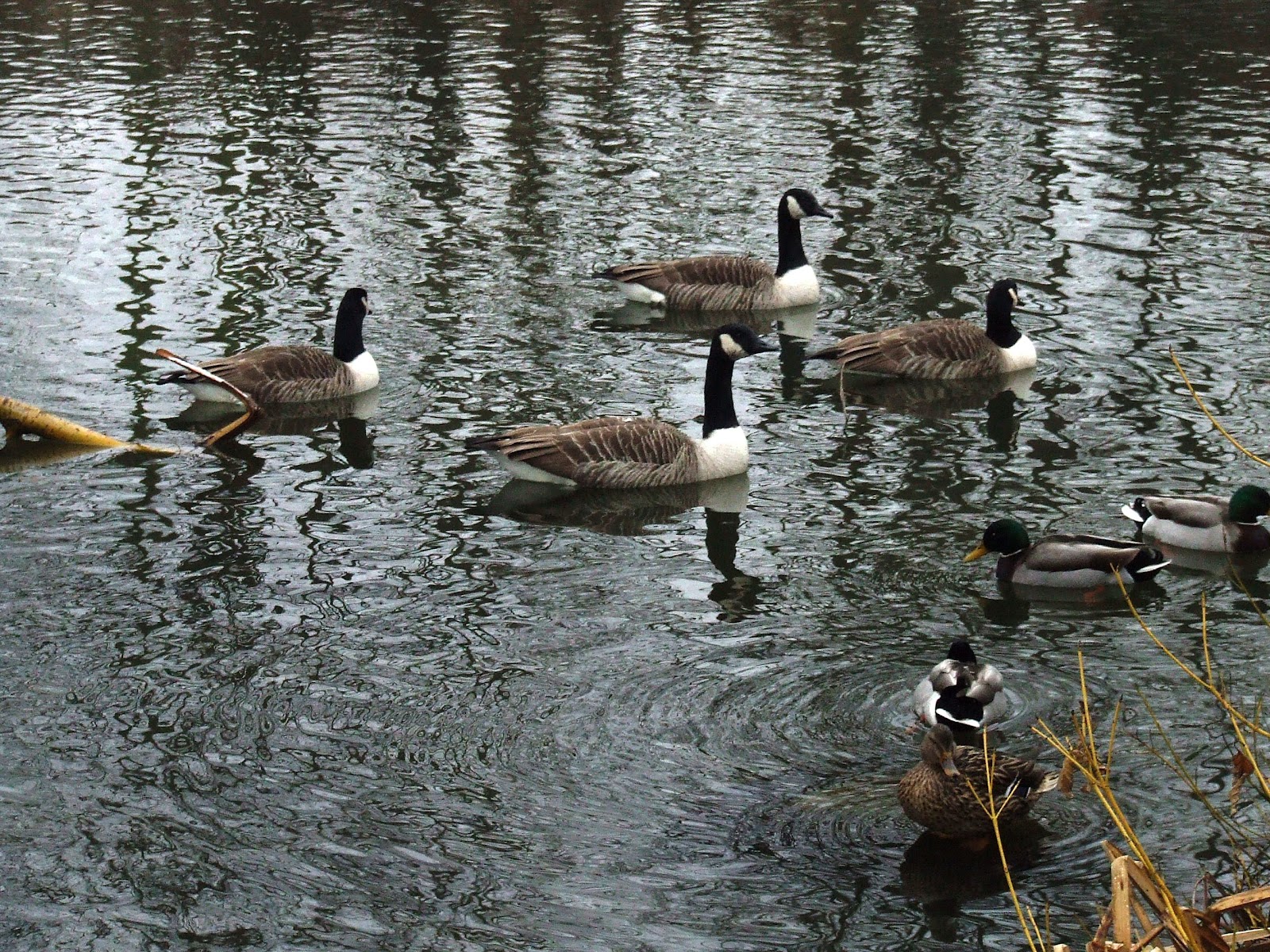
In the swim... geese and ducks on the river.
I walked under the Arches and alongside the river, watching the ducks and the geese on the Anker. The ducks are mallards, but I have no idea about the geese: I looked at photographs I took, and then looked online in a bid to identify them, but I’m really not sure – Canada geese maybe? The Castle Grounds, as ever, were really beautiful, and the Castle was wonderful. I love the Castle, and the way it is always different, depending on the weather, the light, the time of day, the season of the year. Even the colour of the stone it is built from varies. 
The River Anker inTamworth's Castle rounds.
There seemed to be fewer birds around than usual, but a few grey squirrels were out and about, bold and bright-eyed, foraging for food I suppose. As far as plants go, it’s too early for flowers to blooming in the terraced garden, but there are so many trees and shrubs with interesting leaves, trunks and stems that the lack of other colour really doesn’t matter.
Warrior in the snow... he's made from those tiny
flowers used for floral clocks, and is either Saxon or
Viking - I can never remember which!
Walking back through the town centre to the bus stop (it’s uphill on the way home, and I was cold) I treated myself to a bag of toffee bon-bons, or snowballs as I’ve always called them, which seemed considerably smaller than they used to be.

Wednesday, 8 February 2012

Cuthman Carried his Mum in a Wheelbarrow!

Let us all remember St Cuthman who is, quite possibly, the only person to have hailed his ailing mother around in a wheelbarrow. It is to be hoped that this rather unusual mode of transport was in better condition than the rusting wheelbarrow with the wonky wheel which sits at the end of our garden and has never been known to steer a straight (or smooth) path – otherwise the poor woman’s journey would have been most uncomfortable.

A statue of Cuthman created by Penny Reeve.
According to legend the saint, whose feast day is today, lived at the end of the 7th and beginning of the 8th centuries, and was a shepherd who looked after his paralysed mother. Forced to beg for a living, he built a wheelbarrow so he could pull his mother around with him. When his towing rope broke he used willow branches instead, promised that when they snapped he would take it that God wanted him to stop at that point, and he would build a church.   

His journey came to an end at Steyning, in Sussex, so there he stopped and built a church (having first constructed a hit where he and his mother could live – he was obviously a practical sort of a chap). He had divine help with his place of worship, for as he struggled with a roofbeam a stranger gave assistance, telling Cuthman: “I am he in whose name you are building this church.” The church said to have been founded by him is now called St Andrew’s, but it includes a chapel has been dedicated to him.

A stained glass window in the chapel that bears his name shoes
St Cuthman pulling the wheelbarrow whicch bears his mother. 
The saint has also been connected with nearby Chanctonbury Ring. A local story claims the Devil wanted to dig a channel to let seawater flood Sussex and drown everyone, but Cuthmann discovered the plan by knocking a cockerel off its perch and holding a candle behind a sieve, so the Devil thought dawn had arrived, and ran away, leaving behind him the mounds of earth from his digging, which formed hills, including Chanctonbury Ring.

Another tale recounts how Cuthman once used his staff to draw a circle round his sheep while he went to get food, and when he returned the sheep had not moved a step outside this invisible boundary.

I had thought of celebrating his life by using our wheelbarrow to tidy the garden, but I spent much of the day helping to spring clean the Oxfam bookshop where I am a volunteer, and by the time I returned it was much too late to venture out into the garden, so I got my needles and wool out and have been sitting knitting, which strikes me as being a good way to mark the occasion. However, should you wish for a more festive activity I suppose you could feast upon roast lamb.

Sunday, 5 February 2012

Happy Birthday to Sir Robert Peel

Sir Robert Peel - 224 years old today!

Living in Tamworth it’s hard to avoid Sir Robert Peel, founder of the Metropolitan Police Force, who served two terms of office as Prime Minister, and developed a pig which was named after the town. Peel, who represented Tamworth in Parliament, is also known for repealing the Corn Laws, laying the foundations of the modern Conservative Party, and building a stately pile at Drayton Manor – now the site of a theme park.

Today is his birthday: he was born in Bury in 1788, which makes him 224. Should you wish to mark the occasion I would suggest cakes, buns or biscuits would be highly suitable, given the link with Corn Laws. You could, of course, cook pork, or ham, or bacon but, as a vegetarian, I’m not sure I should encourage you to eat meat. Come to that, I’m not sure I should encourage anyone to celebrate the birth of a Tory politician, but he is an interesting historic figure.
                                                                 
Anyway, back to more serious matters. By the early 1790s the Peels had moved from Lancashire to Staffordshire, where they set up home in an old manor house at Drayton Bassett, just outside Tamworth. The future PM’s grandfather had made a fortune printing calico cloth with coloured designs, including a popular parsley leaf pattern which earned him the nickname Parsley Peel. Once in Tamworth the family continued to print fabric, and also established a cotton mill in the town. In addition they rented the historic Castle and installed a forge in the Great Hall – a form of industrial vandalism which seems to have bothered no-one at the time.
Tamworth Pigs, said to have been bred by Sir Robert Peel,
are known as Sandybacks because of their reddinsh sndyish colour.
Peel’s father was the first ‘cotton king’ to become an MP (representing Tamworth) and the young Robert was educated at Harrow and Oxford before he became MP for Cashel, in Ireland, aged just 21, and rose rapidly though the Tory ranks. In 1813 he was Chief Secretary in Dublin, and the following year he founded the Royal Irish Constabulary. Over the years that followed he changed constituencies, holding seats in Chippenham, Oxford University and Westbury before he took over his father’s Tamworth constituency in 1830, a position he held until his death in 1850.

A 'Peeler' pictured roundabout 1850
He became Home Secretary in 1822, and his best known initiative from that period was the founding of the Metropolitan Police Force in 1829 – the officers were nicknamed Peelers, or Bobbies, a term still in use today. However, he was also responsible for overhauling criminal laws; introduced a proper system of payment for jailers; made for provision for the education of prisoners, and cut the number offences which carried the death penalty.

After a period in opposition, in December 1834 Sir Robert Peel drew up the Tamworth Manifesto (which, according to legend, was read to the people from a window in the Town Hall). This document outlined the actions he hoped to take. It was the first time a politician had pledged his policies so openly, and established a procedure which is still being followed by modern political leaders. It is also regarded as the point at which the Tories began the journey that eventually resulted in the creation of the Conservative Party. Peel became Prime Minister, but he led a minority Government and held the position for just a few months, resigning in April 1835, when the Whigs seized control.

I took this photo of Tamworth's
Perl Statue  because I liked the showy cape and cap.
Four years later Queen Victoria asked him to form a Government, prompting what became known the Bedchamber Crisis. Peel, concerned that many of the Queen’s Ladies were the wives and daughters of prominent Whigs, asked for some of them to be replaced with Tory supporters, but the Queen rejected the idea – so Peel refused to form a Government. However, in 1841 the Tories were back in power and he was Prime Minister for the next five years.

In 1848, supported by Whigs and Radicals – but not by his own party - he repealed the Corn Laws, which were originally introduced to safeguard the livelihoods of British farmers and landowners. It is often claimed that he took this action so more food would be available for victims of the Irish potato famine, but it is also possible that he supported free trade At any rate, the decision led to his resignation, and overshadowed his other legislation, including acts which stopped women and children working underground, and limited the length of time they could work in factories.

Peel and his wife Julia had five sons and two daughters and lived at Drayton Manor, the stately home he built on the site of the old manor house in the early 1930s. It was very fashionable, very modern, and had the best of everything – including a central heating system which was admired by Queen Victoria when she stayed there with Prince Albert in 1843. Sadly, the house stood for less than a century and was demolished in 1929, and today only the clock tower remains.

Friday, 3 February 2012

Port and Custard Tart

On this day in 1488 Portugese navigator and explorer Bartholomew Diaz (now referred to as Bartolomeu Dias) sailed around the Cape of Good Hope, travelling further south than any European before him. He was hunting for a sea route to India, so precious spices could be brought back more cheaply than by following overland trade routes. Although he didn’t reach India – apparently his unhappy crew forced him to return home – he proved it was possible to travel to India by sea, and the charts he drew helped Columbus and Vasco da Gama on their voyages.

Diaz named the area at the southern tip of Africa as Cabo das Tormentas (the Cape of Storms), because of the awful weather. However, King John II of Portugal, who had ordered the trip, was optimistic that Diaz’ discovery would open up a new and profitable trade route with the east, so he called the area Cape of Good Hope, or Cabo da Boa Esperança.

In 1497 Diaz sailed to India with Vasco da Gama, and in 1500 he travelled with Pedro Álvares Cabral on a journey which saw the discovery of Brazil, before the expedition made its way towards the south African coast, where Diaz died in a shipwreck during a fierce storm off the Cape.

I thought the statue of him on the South African High Commission building in London (see above left) is interesting, because he looks just like the Portugese soldiers or sailors who appear on the bronze plaques and statues made in Benin City (where modern Nigeria is), which I studied as part of an OU course. The bronzes were largely created during the 15th and 16th centuries (when the Portugese empire was at its height), and some show Portugese visitors alongside the kings of Benin. .They were made from bronze bracelets, which traders from Portugal exchanged for slaves.

Anyway, I felt Diaz’ voyage of 1488 should be marked in some way, so I may have a go at making pasties de Belem, or pasties de nata (that’s Portugese custard tarts in English), which were first made by monks looking for a way to use left-over egg yolks, because they used egg whites to starch clothes and clear the sediment from wine. Wine, of course, would be another way to celebrate – providing it is Portugese. Or some port might be nice.

Meanwhile I am going to sit and read Elizabeth Barrett Browning’s ‘Sonnets from the Portugese’, so-called because Robert Browing called her his little Portugese. And for a musical accompaniment there’s Wagner’s ‘The Flying Dutchman’, since the ghostly vessel is supposed to haunt the stormy waters off the Cape.

Thursday, 2 February 2012

Time to Light a Candle

‘Tis Candlemas today, the time when candles were blessed so they could be used for services in the year ahead. In addition, members of the congregation were each given a candle to take home, which could be lit if they needed protection from the devil during times of crisis, such thunderstorms, childbirth, and serious illness, or when crops were threatened by drought, hail or frost. In the evening people placed lighted candles in their windows, to keep the dark at bay and welcome Christ, the Light of the World.

The custom, apparently, marks the ritual purification of Mary, 40 days after the birth of Jesus, and his presentation to God in the Temple at Jerusalem, where he was held by Simeon who had been told he would not die until he had seen ‘the Lord’s Christ’, and called the baby a Light to the World. As I understand it, the prayer ‘Nunc Dimittis’, which is said at the end of the day, is supposed to be what Simeon said:
Now dismiss Thy servant, O Lord,
In peace, according to Thy word;
For mine own eyes have seen Thy salvation,
Which Thou hast prepared in the sight of all people,
A light to reveal Thee to the nations,
And the glory of Thy people, Israel.
I don’t know how far back the customs of Candlemas dates, but Henry VIII ordered that ‘the bearynge of Candels’ should be done in ‘memorie of Christe, the spirituall lyghte whom Simeon dyd prophecye’, and maybe his order formalised an earlier practice.

Christ th Light of the World, by
William Holman Hunt
Like many other Christian festivals there are all kinds of traditions and customs associated with the day, some of which may have pagan origins. At the end of January and beinning of February the Celts celebrated Imbolc, a festival of light marking the mid-point of winter, half way between the winter solstice and the spring equinox. It was also a time for growth and renewal. Many customs are connected with the weather, since people believed that conditions for the rest of winter depended on conditions on Candlemas Day – I suppose some indication of what lay ahead must have been important if there was ground to be prepared and seeds to be sown for crops. One rhyme said:
If Candlemas Day be fair and bright
Winter will have another fight
If Candemas Day brings cloud and rain
Winter will not come again.

On the same theme, it was believed that badgers came out to look at the weather, and would only stay above ground if it was snowing – in sunny weather they would return to their setts because, presumably, bad weather was on the way. And another piece of weather law insisted that if ‘ thorns hang adrop’ with icicles you could be certain of a good pea crop

Folklore also recommended that:
A farmer should on Candlemas Day
Have half his corn and half his hay.
This sounds like a sensible precaution if their animals were to survive on stoed food for the rest of the winter.

And there are various legends about snowdrops, which traditionally bloom in February. According to one tale an angel made them flower as a sign of hope to Eve, but they are also seen as a symbol of Jesus being this hope for the world – just as lighted candles placed in windows on the night of Candlemas are said to represent Christ  as the ‘light of the world’.

By the way, Candlemas is regarded as the last day of Christmas, so if you forgot to take down your decorations on Twelfth Night, don’t worry: you have been given a period of grace and may avoid bad luck, as long as you remove them today.  And if you want to celebrate this festival, then cook a special meal and eat it by candlelight... or put a bunch of green leaves in a vase... or plant a seed to grow as spring approaches... or read TS Eliot’s ‘A Song for Simeon’.


Monday, 7 November 2011

A Grisly Tale about Tyburn Tree

Illustration, from about 1680, showing the gallows at Tyburn. Prisoners travelled
the three-mile journey from Newgate prison in an open cart, followed by crowds of people who watched the hanging.
Today I have a grisly tale to tell, for on November 7 , 1783, John Austin was the last person to be hanged at the infamous ‘Tyburn Tree’, the gallows which once stood at the junction of Edgware Road and Bayswater Road, near Marble Arch, in the heart of London.

Actually, before I continue I should admit to having some reservations about the date of this event – some sources list it as taking place on November 7, while others claim it happened on November 3. Anyway, the month is correct, even if the day is wrong, and he definitely appeared in court on October 29, 1793 – you can read the transcript of the trial at the Proceedings of the Old Bailey web-site  http://goo.gl/f5OmF.

According to this, John Austin was indicted for ‘feloniously assaulting’ John Spicer , in a ‘certain field and open place, near the King's highway, on the October 23,  putting  him in ‘fear and danger of his life’, and ‘feloniously taking from his person and against his will’ one silver watch, value 30 s. a steel chain, value 1 s. a steel key, value 2 d. two silk handkerchiefs, value 4 s. two pair of worsted stockings, value 4 s. one linen shirt, value 12 d. one man's hat, value 12 d, which were all the property of  the said John Spicer.

The victim told the court he came to town from Essex, and two men that he did not know offered to show him a good lodging, but instead took him to some fields. “One of them took me to a ditch, he said, we cannot well get over here, then he took me to the corner; the other, which is the prisoner, had stopped to do his occasions,” said Mr Spicer. “The other man drew a cutlass, from under his smock frock, and he said, if I did not give him what I had, he would cut me down, I got hold of him, and made a good deal of resistance, he chopped at me several times, and cut away as hard as he could,” he added.

A map of Tyburn gallows from John Rocque's 1746 map of London, Westminster and Southwark.
Austin grabbed Spicer’s neckerchief and his leg, then threw him down on the ground, where he lay on his back while the assailants tied his hand together with a cord and took his possessions. “A person came up or else I think they would have killed me,” Mr Spicer said. His rescuer, a gentleman’s gentleman, described how  he John Spicer with ‘both his hands tied together all over blood almost’, and added that he was taken to the infirmary where ‘we expected he would have died’.

Stolen property was found on  property was found on Austin when he was captured, but in court he maintained his innocence, claiming he was ‘easing’ himself when the attack occurred, and did not know the other man. “When I went up to him, he said, damn you, if you will not assist me, I will blow your brains out,” Austin claimed. “I have no witnesses, I have never a friend in the world, I am far from friends.”

He was found guilty and sentenced to death. At the gallows he reportedly said: “Good people, I request your prayers for the salvation of my departing soul. Let my example teach you to shun the bad ways I have followed. Keep good company, and mind the word of God. Lord have mercy on me. Jesus look down with pity on me. Christ have mercy on my poor soul." As the cart on which he stood was driven away from the gallows, the noose around his neck slipped, and he choked to death rather than having his neck snapped.

After Austin’s execution hangings were carried out at Newgate Prison, but it was almost 100 years before legislation was introduced to ensure they were conducted in private, and it took another 100 for capital punishment to be abolished. Today a circular plaque on a traffic island at Marble Arch commemorates the Tyburn Tree.

Incidentally, the phrase 'money for old rope' came into being because after executions, hangmen used to cut the noose up and sell it. And, according to legend, the term 'on the wagon' also has a connection with the last journey of condemned prisoners, for they were allowed a final drink on the way to Tyburn, before going back on the wagon to their grim destination
Image of the stone commemorating the Tyburn site on the traffic island at the junction of Edgware Road and Marble Arch.